Fireman James Fegan
Newry Flour Mills
Clanrye Mills
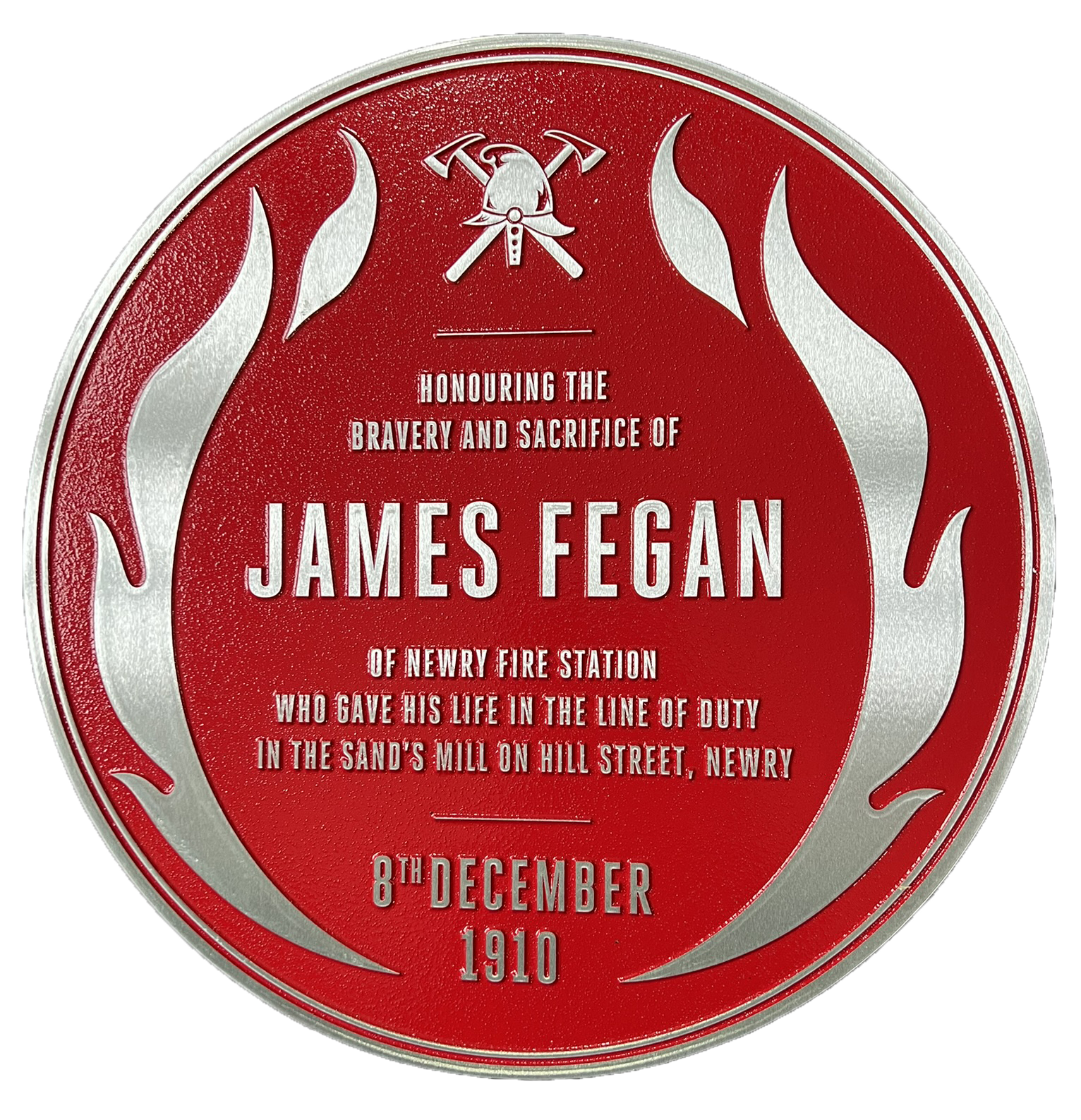
James Fegan was a fireman who was employed for more than 20 years by Newry Urban Council. He lost his life aged about fifty fighting the fire that destroyed Newry Flour Mills on 8 December 1910. Three days later the fire was still smouldering and bursting into flames, and the entire front wall of the mill premises in Mill Street collapsed. The search for James was unsuccessful and it was feared he would never be found.
At the inquest, it was recorded that James was in charge of the stand pipe at the Cathedral but was ordered to go into the Newry Reporter printing works to retrieve a hose from an upper storey. He wasn’t seen after that and it was a full week before his remains could be recovered. Captain Maginnis of the Fire Brigade confirmed they had only found the head of James’s fire hatchet, the key which he used for coupling his hose and the steel protector on the heel of one of his boots, together with a few charred bones. A door key was also found, which one of his sons identified as his father’s. According to a report in the Northern Whig, the calcined bones were principally from the spinal column and were enclosed in a small cardboard box 8 by 3 inches, so very little had been found.
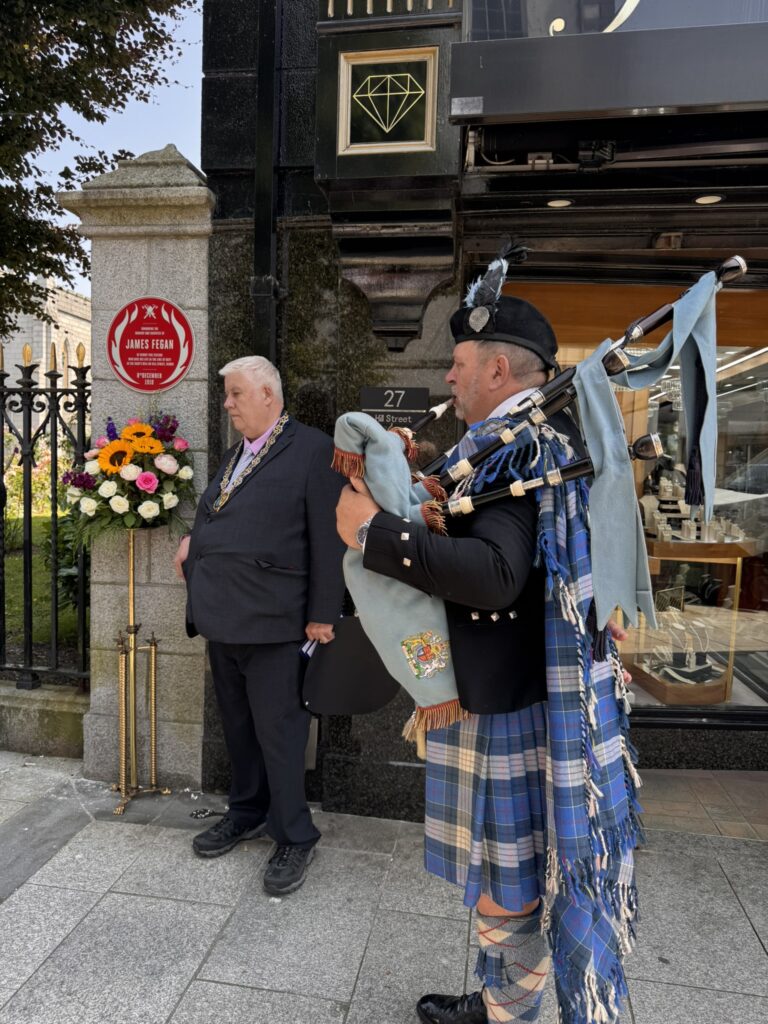
Thirteen years earlier James had had a narrow escape when he was rescued from premises in Hill Street by Captain James Heather of the Fire Brigade. He was overcome by fumes near the top of the house and was carried through the smoke and flames by Mr Heather. At the next meeting of the Town Commissioners the Fire Brigade was congratulated for its excellent effort, but when Doctor McEvoy claimed two guineas from the Commissioners for reviving James, one of them had the gall to suggest that since Fireman Fegan had received seven shillings and six pence for fighting the fire he should pay the good doctor himself!
On Wednesday 4 January 1911, his remains were buried at St Patrick’s Church of Ireland churchyard in Newry. The cortege included all the council employees, its Chairman, and some council members. The chief mourners were his three sons.
The mother of James’s children was Rose Ann Convery, aged 55, who had been living with James at 3 Nicholson’s Court with their children, Minnie (Mary), aged 24, a mill worker; James aged 23, a machine boy; Patrick, aged 21; Charles aged 17; and Annie E (Elizabeth, or Lizzie as she was known), aged 12, all Roman Catholics. The family claimed compensation and received £150, which was apportioned amongst the children. Rose was appointed their guardian and was expected to use the interest towards their support. Two of his sons had also worked for the council as ‘call boys’ for the Fire Brigade.
Rose, who had been no stranger to drink, was found floating in the Albert Basin on 10 November 1915. At her inquest the jury agreed that her death was accidental and she had died from drowning.
James and Charles enlisted when the First World War was declared, James in the Royal Irish Fusiliers and Charles in the Royal Dublin Fusiliers. Private Charles Fegan died aged 24 on the 21st March 1918 and is remembered on the Pozieres Memorial. It is unclear what became of James, although he might have died in 1931, was married and had a daughter, Margaret Clare Fegan.
Patrick was discharged from the Royal Irish Fusiliers on 5 November 1914 ‘in consequence of not likely to become efficient on account of misconduct.’ He could have been the Patrick Fegan who died on 19 April 1924.
Of James’s two daughters, Lizzie has left no record, but Mary married a Mr McDonald between the census on 2 April 1911 and her mother’s death on 10 November 1915. He may have been Thomas McDonald, one of the five sons of Mary McDonald who lived at 4 Cornmarket, close to Nicholson’s Court. Thomas certainly knew her brother James because they were charged with trespass when they entered a lighter on 4 May 1911. Tracing Mrs Mary McDonald of 2 Church Street in 1916 has so far been unsuccessful, with no leads resulting in a positive identification of her family or any descendants.