Edward Sinclair of Strom (Part II)
Edward was a staunch catholic and a close ally of Bishop Robert Reid. On 26th October 1549, the bishop leased Skokness in Rousay to Edward and his wife Margaret Dishington, describing Edward as “ane honourable man, Edward Sinclair of Strome has shawn in deed his faytful kindness and tane a trewe part with us and our friendis, and speedlie in the defenss of the Chrysten fayt and libertie of haly kirk.” Prior to that, Edward had been one of the witnesses to Bishop Reid’s new constitution of the church, signed and sealed at St Magnus Cathedral on 28 October 1544.
In 1548 at Strom, Edward bought 2 merks of land in Watsay in Nesting in Shetland and at the same time acquired another 4 merks of land from John Sinclair and his spouse Katherine Hendriesdochter. This was land which had previously been bought by Henry Phankouth, but the couple had failed to pay rent on the land for the previous eight years, so John and Katherine gave up their right to it in settlement of the debt. Presumably this was land which Edward had inherited from Henry Phankouth. It is tempting to speculate whether Katherine was another illegitimate daughter of Henry Phankouth and, indeed, whether John Sinclair was somehow connected to Edward, but we have no way of knowing for sure.
There is a record of a burgh court held at Edward’s own “new” house in the midtown of Kirkwall on 21st October 1549, where the court debated the facts about a tenement mentioned in a sasine granted to Marion Cromarty and her spouse, Nicol Tulloch, in 1529. It seems this tenement had been given by Edward to his brother, Sir James of Brecks, on condition James paid £40 in marriage goods to Marion Cromarty, which he failed to do. Instead, he had given the tenement to the married couple to be enjoyed by them and their heirs. As it formed part of another sasine of other lands, no legal conveyance of that specific tenement had been made at the time. The other interesting note is that Edward’s eldest son, Henry of Strom and Brugh, was also present in his capacity as the first known Provost of Kirkwall.
In 1550, Edward bought Essenquoy, Clett and Gramesetter in Orkney from his nephew, William Sinclair of Warsetter, who had financial problems, and those lands were eventually inherited by his youngest son, Oliver.
In 1554, Edward exchanged some land with Margaret Reid and her husband Gilbert Cant who lived at Brough in Nesting, Shetland. He exchanged land in Wassay, Nesting for land in Howll in Tingwall and land in Neip in Nesting for land in Catfirth in Nesting. “Edwart Sinclar of Strome subscryvit this present chartour with my hand at the pen led by my sone, Robert Sinclair” – he was known later as Robert of Ness. Edward’s eldest son Henry would ultimately buy the lands of Brough from Margaret Reid in 1560.
Edward’s war-like antics were not yet over, however. English fleets had been attacking the north isles of Orkney for centuries; in fact, it is likely Earl Henry Sinclair himself died in one such raid on Orkney around 1400. King James V complained in 1535 that English fishermen were attacking the north isles and carrying off the islanders “as slaves.” Despite his request and with continuing skirmishes in retaliation for a Scottish attack on the English borders, Queen Mary Tudor ordered her Vice-Admiral, Sir John Clere of Ormesby, to take thirteen English ships with a force of men and arms to harass the west coast of Scotland and to burn Kirkwall.
On the 11th and 12th of August 1557, they landed at Kirkwall and burnt part of the town, destroyed the parish church of St Olaf’s, captured St Magnus Cathedral and brought ashore artillery in an attempt to bombard the castle, which was unsuccessful. By the time they landed again on Friday 13th August, intent on capturing Bishop Reid’s palace, Edward of Strom had hastily assembled a force of about three thousand Orcadians who were assembled at Papdale, where the two sides came face to face. A sudden storm whipped up in the bay, which trapped the English on shore. During the battle it is said that ninety-seven Englishmen were killed, including three ships’ captains and Sir John Clere himself, drowned when his boat capsized as he tried to return to his ship. However, another version puts the English dead at three hundred, along with another two hundred men, including the three captains, who drowned trying to reach their ships. There is also some dispute as to whether Sir John Clere actually drowned at all. Nonetheless, many English guns were captured, with many prisoners taken and subsequently ransomed, raising a considerable sum of money. The last pitched battle on Orkney soil, known as the Battle of Papdale, was a humiliation for the English, who had grown accustomed to raiding the islands with impunity and as W P L Thomson says, it “rivalled Summerdale both in the scale of the engagement and in the comprehensive nature of the victory.”
Bishop Reid died in Dieppe in France in 1558 and Edward did not have a similarly close relationship with his successor, Adam Bothwell, the first Presbyterian reformation-era bishop in Orkney. Edward accepted the ban on celebrating mass, albeit probably reluctantly. His sons, Robert of Ness and Henry of Strom and Brough, however, were much more vocal and led the catholic opposition to the reforms Bothwell had been appointed to oversee. In January and February 1561, after Bothwell locked the doors of the Cathedral to prevent mass being celebrated, he stood firm, despite crowds of people protesting outside. It culminated in the Sinclair brothers leading angry mobs around the town, eventually forcing their way into the chapel at the Bishops Palace and bringing a priest in with them, who proceeded to “marry certain people in the old manner” despite Bothwell lying on his sickbed in the very same building. Henry of Strom and Brough submitted a petition listing what he and his supporters considered to be Bothwell’s mutation of religion, which Bothwell showed to Edward, as the Sheriff-depute, and appealed to him for help. But Edward simply remarked that his sons were “fools that wist not [did not know] what they did.” Although he was not willing to allow mass to be performed, he was not prepared to take any action against his sons and their followers. Instead, he urged Bothwell to answer the grievances put to him, but the bishop refused to do so on principle until the rebels had vacated his palace. Despite this standoff, Bothwell was back in possession of his palace by 25th March 1561, and his reforms to the church continued, mostly unchallenged.
Edward continued his duties as Sheriff-depute and as principal baillie of St Andrews parish, presiding over local court cases there. On July 5th 1561, “for the filial love he bore towards his son, Oliver” he gave Oliver a tack of lands in Sandwick in Deerness and the outright gift of Sandside in Deerness.
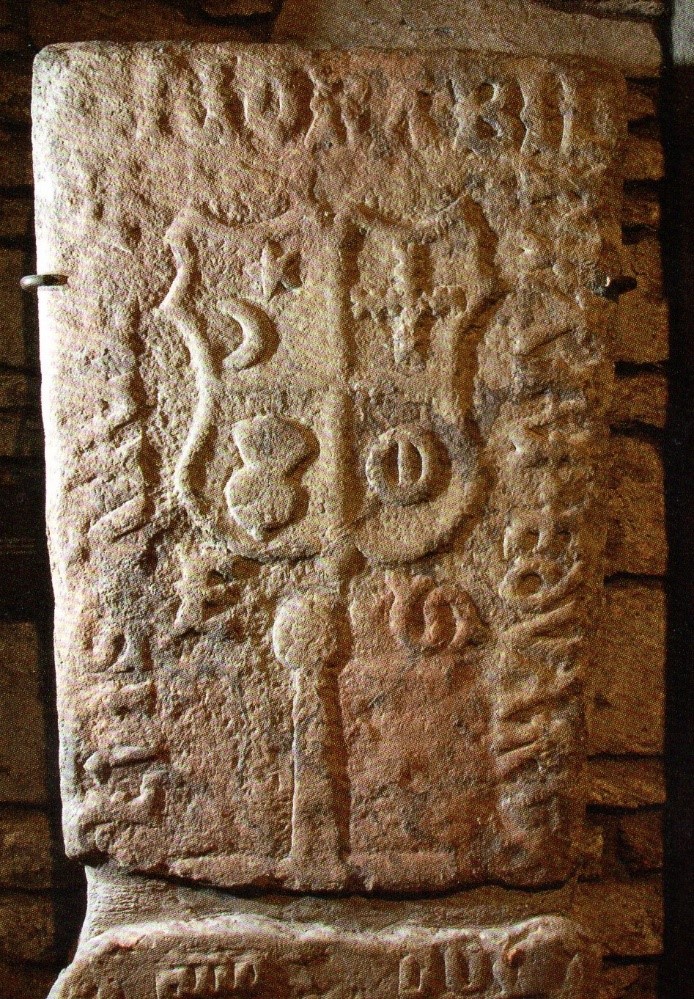
On 17 July 1563 in a court case heard in Edinburgh, Edward appeared as a witness over a dispute about land in Shapinsay and Kirkwall. His last appearance in the records was in Kirkwall on 12 April 1564 when he and his son, Robert of Ness, were witnesses to a contract between Edward Sinclair of Eday and James Pierson. It is not known exactly when he died but he was buried honourably in the south choir aisle of St Magnus Cathedral, where his tombstone can be found, although it is much eroded, partially broken and any date is now illegible. All that can be read is “… lyis an honorabil man Edvard…” with the initials E and S and the Sinclair engrailed cross on the coat of arms, along with the hilt of a two-handed sword, to commemorate the victor of Summerdale and Papdale.
To quote J Storer Clouston, “The Sinclair families of Brough in Shetland, Ness, Campston, Essinquoy, Flottay, Gyre, Greinwall, Damsay, Ryssay and Smoogroo in Orkney were all descended from him – a goodly crop!”
Nina Cawthorne
DESCENDANTS
m. (1) unknown Phankouth
Christian Sinclair (abt 1523- )
Robert Sinclair of Ness (abt 1525-abt 1588) [ancestor of Sinclairs of Campston, Ness, Damsay, Smoogroo, Ryssay] m. unknown dau of Hugh Kennedy of Girvanmains
unknown son [ancestor of Sinclairs of Flotta, Gyre, Greinwall (Orkney)]