Edward Sinclair of Strom (Part I)
Edward was the brother of Sir James Sinclair of Brecks, another son of Sir William Sinclair of Warsetter. Both brothers are usually noted as illegitimate and, according to J Storer Clouston, their mother must have been from the Cara family from South Ronaldsay, although her first name is not known. Clouston reached that conclusion due to the fact the brothers both held udal land which had previously been in the Cara family’s hands. He also suggests they may have been born of their father’s first marriage to an heiress of the Cara family, which was later annulled in order that he could marry Ellen Gordon. Legally, that would have meant the brothers immediately became illegitimate, being born of a marriage which was no longer recognised under the law.
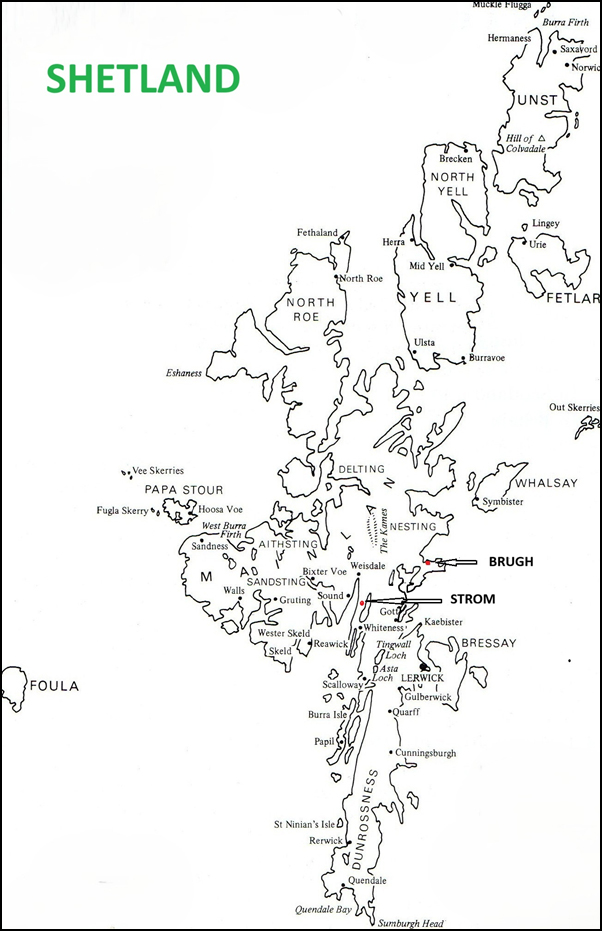
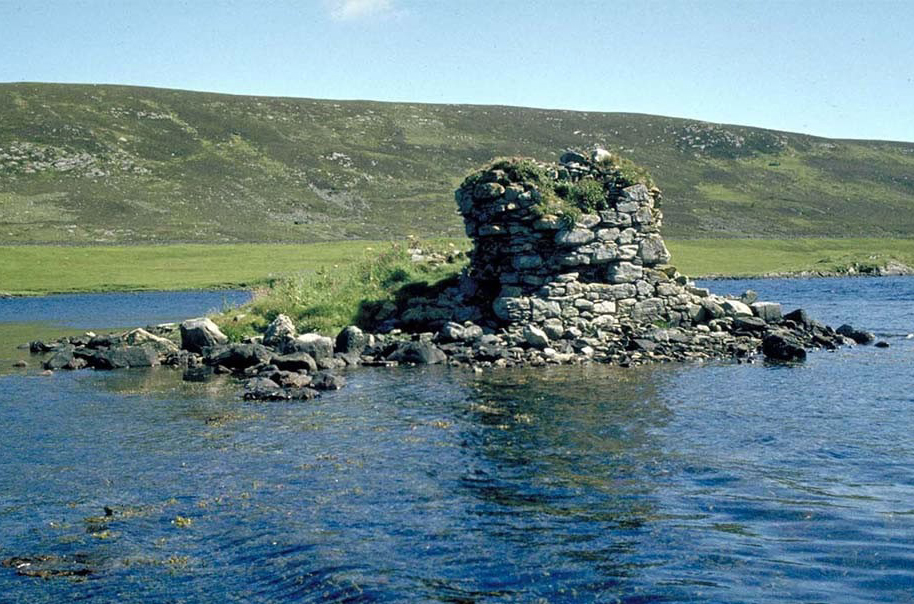
Edward’s early years were very much caught up with that of his brother. He held the estate at Strom in Whiteness in Shetland and also had various properties in Orkney. In those days, where the sea lanes were the roads, travelling between the islands or even mainland Scotland was no problem if you had your own ship. James and Edward were governing the islands just as their father had done. They took on the collection of the Orkney and Shetland rents and then delivered them to Dysart in Fife to Lady Margaret Hepburn, Lord Henry Sinclair’s widow, who after 1513 held the tack in her own name. That did not always happen, however. There were problems during several years when Lady Margaret’s payments to the Exchequer were either in arrears, or not paid at all. William P L Thomson has suggested that the brothers may have been misappropriating some of the rent for their own ends. Certainly, in 1525, one of Lady Margaret’s reasons for a shortfall in the rent was because the island had been “completely laid waste” by the Sinclair brothers, culminating in her being allowed an £80 remission by the Exchequer. He also suggests their actions may have been in revenge for the fact the Crown had recently rewarded Lady Margaret with the gift of the late Sir David Sinclair of Sumbrugh’s estates. Friction arose between the Sinclairs at Dysart and their Orcadian cousins which was exacerbated further when Lord William, Margaret Hepburn’s son, began to exert his influence. Tensions eventually erupted in the battle at Summerdale in 1529, with the Caithness Sinclairs joining in on the side of Lord William as well. More details on the battle and what led up to it can be found at Sir James Sinclair of Brecks.
In the aftermath of the battle, Edward was sent by his brother to Shetland to slay Magnus, one of the sons of his great-uncle, Sir David Sinclair of Sumburgh, along with three of his followers. He did not stop there; he also killed seven more of Lord William’s supporters in a barn somewhere in Shetland. The opposition was completely eradicated without mercy, and the Sinclair brothers were then in complete control of the islands. James only lived a few more years before committing suicide in 1536. At that point, Edward stepped fully into his elder brother’s shoes, acting as “foud” or lawman in the islands and continuing to collect the rents on behalf of Lady Margaret, which seemingly arrived in Dysart regularly.
Edward was very close to Henry Phankouth, the Archdeacon and senior clergyman in Shetland, who was appointed in 1501. It also seems very likely that Edward married Henry’s illegitimate daughter, having three children by her and indeed naming his eldest son Henry after her father. Her name is not recorded and nothing more is known of her. Phankouth’s appointment had been loudly contested by both Lord Henry Sinclair and Sir David Sinclair of Sumburgh at the time, as they had both supported the appointment of Sir Magnus Herwood, he being a family friend and the chosen candidate of the King of Denmark. However, in January 1502, Lord Henry as principal justice, was ordered in the Scottish king’s name to ensure that Henry Phankouth was to have no trouble in the peaceable entry to the Arch deanery “under pain of treason” and subsequently he was left in peace. Perhaps Henry Phankouth felt a little safer having Edward of Strom on his side.
On 24 June 1536, Edward was at Voesgarth in Unst, Shetland, where he sold 5 merks of land at Russater in Fetlar to Adam of Still; Edward is noted as “Foud of Shetland”, an office whereby he collected various taxes, tolls from foreign merchants, and presided over the Lawting or court, just as he did in Orkney. He had certainly rehabilitated himself since 1529!
Henry Phankouth’s daughter probably died relatively young, certainly before 1539, when Edward married Margaret Dishington, the daughter of George Dishington from Ardross in Fife. Phankouth’s time as Archdeacon had come to an end ten years earlier when he resigned his post, coincidentally, the same year as the battle of Summerdale. There are charters included in a 1575 inventory within the Sinclair of Brugh papers preserved in the Shetland Archives, which make it clear the Archdeacon had made Edward of Strom his heir. Phankouth had land in both Orkney (where he was based) as well as in Shetland. Yet another undated paper in the same inventory indicates that Robert Sinclair of Ness and Christian, Edward of Strom’s son and daughter, gave up their rights to their share of their mother’s property in Shetland to their elder brother, Henry of Strom, later of Brugh. All three shared the same parents, unlike Edward’s other son, Oliver of Essenquoy, who was the son of Margaret Dishington.
By the late 1530s, James V had grown tired of the ongoing complaints from Lord William Sinclair over the years since Summerdale and eventually demanded the feud be resolved once and for all. In September 1539, Lord William and Edward of Strom were at Falkland Palace in the presence of the king, where they both agreed to an alliance with the aim of pacifying the islands and restoring good governance on pain of £2000 surety. Oliver Sinclair of Pitcairn, a younger son of the Earl of Roslin, was one of the signatories, indicating his influence as a favourite of the king with a continuing interest in matters in the far north. Two weeks later, Edward, his half-brother Magnus Sinclair of Warsetter, six other Sinclairs plus twenty-four other Orcadians and Shetlanders were granted a formal respite for their part in the murder of the Earl of Caithness at Summerdale, plus any crimes they had committed in the ten years since then.
The following year, King James V visited Orkney with his favourite, Oliver Sinclair of Pitcairn, as well as Lord William Sinclair in tow. He instigated sweeping changes; he garrisoned Kirkwall Castle and the Bishop’s Palace with troops and appointed a new Bishop, Robert Reid, the founder of Edinburgh University, who set about restructuring the church. The other change resulting from the king’s visit was that Lady Margaret Hepburn’s tack was cancelled, even though it still had three years to run. She was handsomely compensated with an annuity of 500 merks, however. Oliver Sinclair of Pitcairn was appointed in her place from 1541 and whereas her tack had yielded £433 6s 8d per annum for the king, Oliver’s payment was vastly increased to £2000 per annum, probably as the king had now seen for himself just how profitable the islands could be. Oliver was also appointed the first Sheriff in the islands where there had previously been Lawmen or “Fouds”, and he appointed Edward as his “very lawful and undoubted baillie” or Sherriff-depute, as he was otherwise titled.
At St Magnus Cathedral in Kirkwall on 16th June 1534, Edward bought some land at Deerness in Sandwick from Thomas Alexandersone and his brothers, and on 11th July 1543 bought 4 marks of land in Tankerness, St Andrews parish, for £8 from Cristiane Maison. On 29th August 1546 he exchanged 6 marks of land in Onston, Stenness, for 6 marks of land in Campston, St Andrews, with John Leith and the other heirs of his parents, John Leith and Margaret Cromarty.