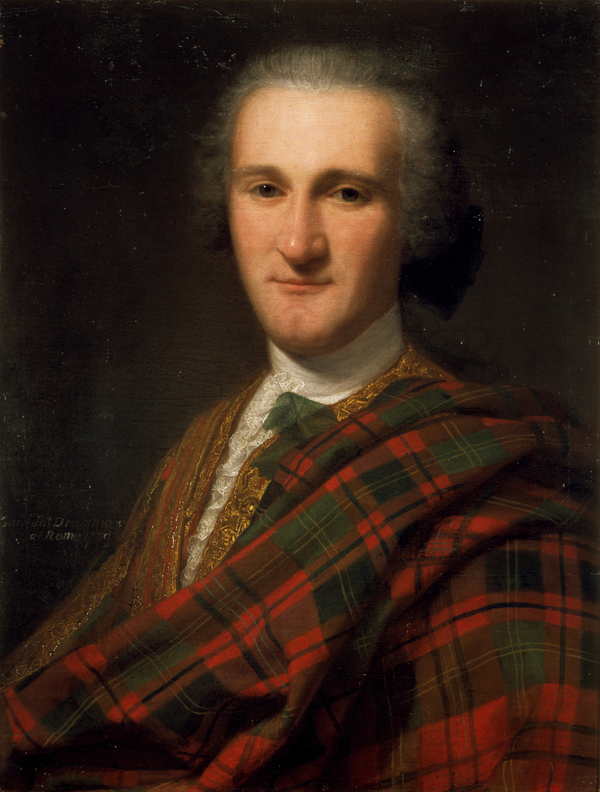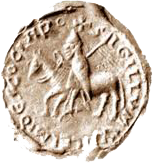
Lady Elizabeth Sinclair and Sir John Drummond
The ties between the Portuguese Drummonds and the Scottish Chiefs were defined by a documented claim of kinship that spanned three centuries, sustained through correspondence, heraldic gifts, and shared political sympathies.
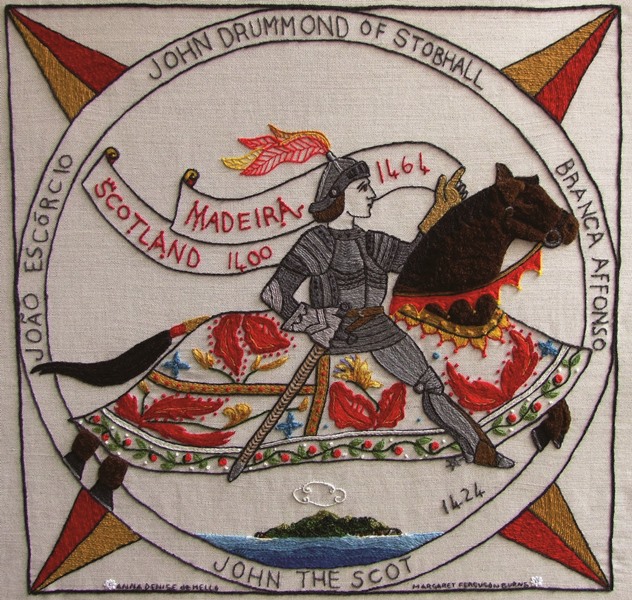
The progenitor of the Portuguese line, known in 15th-century Madeiran records as João Escórcio (‘John the Scot’), was identified by his descendants and the Scottish Chiefs as John Drummond. According to family tradition, Escórcio revealed his true identity as the son of Sir John Drummond of Stobhall and Cargill, Chief of the Clan Drummond, and Lady Elizabeth Sinclair during a deathbed confession. This parentage placed the Portuguese branch in the direct line of the Scottish Chiefs and established a royal connection, as Sir John Drummond was the brother of Anabella Drummond, Queen of Scotland.
Formal ties were established in 1519 when Thomas Drummond, a kinsman of the Chief, visited Madeira and became acquainted with the Portuguese family. This led to a formal exchange between Manuel Afonso Ferreira Drummond and the Chief, Lord David Drummond, who issued a letter recognising their common Scottish ancestry. Subsequent generations maintained this link through further correspondence:
- In 1604, Martim Mendes de Vasconcelos Drummond sought credentials from Lord James Drummond (later 1st Earl of Perth) to present to the Spanish and Portuguese courts.
- In 1623 and 1634, Portuguese family members wrote to Lord John Drummond, 2nd Earl of Perth, seeking continued validation of their lineage.
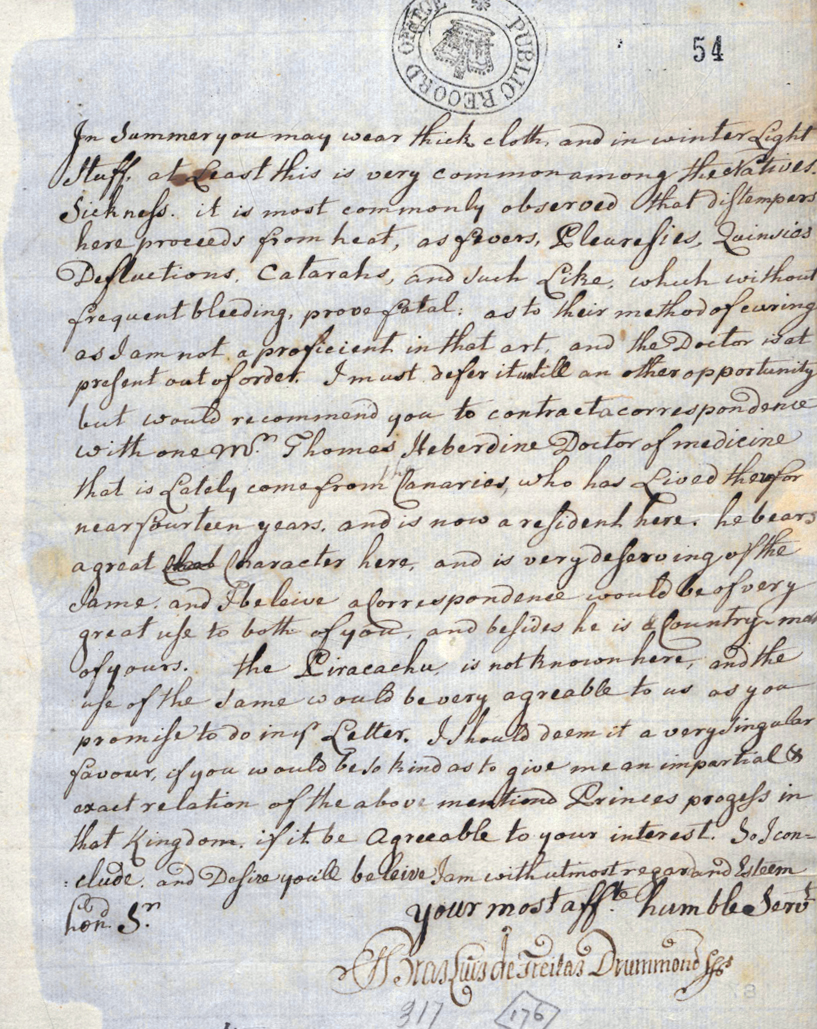
- By 1745, Brás Luís de Freitas Drummond was in contact with the Scottish branch, expressing Jacobite sympathies and pledging support to the Duke of Perth.
A significant symbol of these ties was the gift of armorial bearings. In 1519, the Chief granted the Portuguese Drummonds the right to use his arms, accompanied by an attestation of their origins allegedly supported by high-ranking Scottish officials, including the Archbishop of St Andrews and the Earl of Angus. This recognition allowed the Portuguese branch to petition for and receive official grants of arms from the Portuguese Crown – first in 1536 and continuing into the 18th century – which were variations of the Scottish Chief’s own heraldry.
The influence of the Scottish Chiefs was substantial enough to aid the social mobility of their Portuguese kinsmen. For example, the credentials provided by the Scottish Chiefs are believed to have helped Vasconcelos Drummond secure the position of Governor of Porto Santo. Furthermore, the sense of kinsmanship was so strong that Portuguese family members followed the political fortunes of the Chiefs, with Brás Luís de Freitas Drummond mourning the reported loss of the Duke of Perth at the Battle of Prestonpans.
My thanks to Jonathan J F Sykes for his article on ‘The origin of the Portuguese Drummonds: a Scotsman in late medieval Madeira?’ published in the Proceedings of the Society of Antiquaries of Scotland (November 2003).
Peter Sinclair
DESCENDANTS
The following descendant table has been provided by Getúlio Felipe de Souza Barros (1990-), who has traced his origins from Elizabeth Sinclair and Sir John Drummond through their granddaughter Branca Afonso Drummond. It has been provided because of its considerable interest to the study of Scottish migration in the late medieval period and what is known about Sinclair descendants who served in European armies and the ‘Régiment de Douglas’ and ‘Le Régiment des Gardes Ecossais’. See Colonel Henry Sinclair.